APR vs Interest Rate: What’s the Difference?
· · Payday Loan Guides
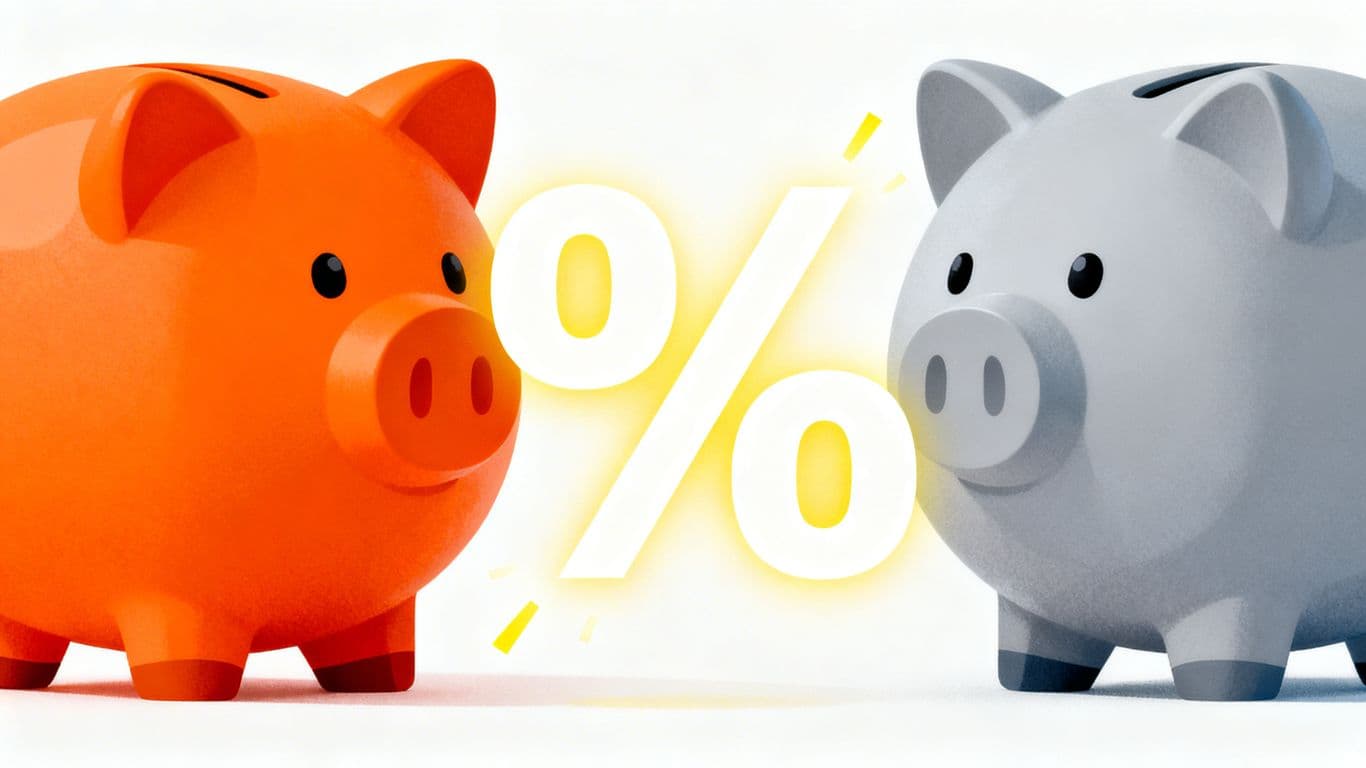
An interest rate is the base price of borrowing money, while APR (annual percentage rate) is that price plus most fees, expressed as a yearly rate. Federal law, the Truth in Lending Act, requires every lender to disclose APR so you can compare offers on equal footing. When a loan carries no fees, the two numbers are identical; when it carries fees, the APR is the higher, more complete figure.
The distinction matters most where the numbers look strangest. Every licensed payday lender in Utah must quote an APR, and ours can be startling on paper: our standard rate of $17.26 per $100 borrowed works out to 450% APR, while a credit card might advertise 25%. Does a two-week loan really cost eighteen times more than a credit card? Not in dollars: APR annualizes the cost, and annualizing a 14-day fee multiplies it roughly 26 times. That’s why short-term loans carry triple-digit APRs even when the dollar cost is modest, and why you need both numbers, plus the dollar figure, to make a smart decision.
Key Takeaways
- An interest rate is the basic cost of borrowing money, shown as a percentage. APR is the interest rate plus most fees tied to the loan, annualized.
- Because APR bundles in fees, it’s usually higher than the interest rate alone, and it’s the best tool for comparing loans of the same type and term.
- For very short terms, APR multiplies the fee about 26 times (365 ÷ 14 days). Always look at the dollar cost of a short-term loan alongside the APR.
- When a loan has no fees at all, APR and interest rate are the same number. Our signature loans work this way.
- Utah puts no cap on payday loan fees, so comparing each lender’s fee per $100 (not just the ads) is what actually saves you money.
Understanding The Core Difference
What Exactly Is An Interest Rate?
An interest rate is simply the cost of borrowing money, shown as a percentage of the amount you borrow. It’s the base price tag for the loan, before any fees. Lenders use it to calculate how much extra you’ll pay back over time, and borrowers with stronger credit or (in our case) a longer repayment history generally get lower rates.
What Is An Annual Percentage Rate (APR)?
APR is also a percentage, but it includes the interest rate plus most other costs of getting the loan: origination fees, closing costs, certain required charges. The idea is to give you one number that reflects the total yearly cost of borrowing. In the U.S., the Truth in Lending Act requires lenders to disclose the APR before you sign anything.
The Key Distinction Between Them
The interest rate is the cost of the money itself; the APR is the cost of the money plus most of the fees that come with getting it. Think of a purchase: the interest rate is the sticker price, and the APR is closer to the checkout total after fees are added. For most loans with fees, the APR will be higher than the interest rate.
Why APR Gives You The Full Picture
Loans often come with costs that aren’t interest: an origination fee for processing the loan, application fees, closing costs on a mortgage, or points paid upfront. Individually these look small; together they can change which of two offers is actually cheaper.
APR bundles those extras into one comparable percentage. A loan with a low advertised rate but heavy fees can carry a higher APR (and a higher real cost) than a loan with a slightly higher rate and no fees. That’s the whole reason regulators standardized the number: so lenders can’t hide the true cost in the fine print.
How Interest Rates Work For You
Most simple interest follows one formula: principal × rate × time. Borrow $10,000 at 5% for one year and you pay $500 in interest. Payday loans in Utah use the same math over a much shorter window; more on that below.
One more distinction worth knowing: a fixed rate stays the same for the life of the loan, so payments are predictable. A variable rate can move with market conditions, often lower to start, but with the risk of rising later. Every Beehive loan is fixed-rate: the cost quoted at signing is the cost, period.
What APR Means On A Two-Week Loan
Here’s where APR gets misread most often. A payday loan runs about 14 days; Utah law caps the total term at 70 days (Utah Code 7-23-401). APR, though, is an annual rate, so disclosing it means multiplying that two-week cost by roughly 26 (365 ÷ 14).
Run our standard rate through the math:
- Fee: $17.26 per $100 borrowed for 14 days; that’s 17.26% for the term.
- Annualized: 17.26% × 26.07 = about 450% APR.
Same loan, two very different-looking numbers. The APR isn’t wrong (it’s the honest, legally required way to state the cost), but nobody holds a payday loan for a year. For a two-week loan, the dollar cost is the number to compare: $300 borrowed at our standard rate costs $51.78 in interest, whether you think of that as 17.26% for two weeks or 450% annualized.
This matters in Utah specifically because the state sets no cap on payday loan fees. Licensed lenders here commonly charge $20 to $30-plus per $100, roughly 520% to 780%-plus APR. Comparison shopping on the fee per $100 is the single most effective way to pay less. Beehive Loans is a Utah DFI-licensed direct lender, and our current fees and the full disclosure math are published on the rates and fees page.
When Are APR and Interest Rate the Same Number?
The Credit Card Exception
For most credit cards and revolving credit lines (like HELOCs), the APR is the interest rate. These accounts typically don’t charge the upfront fees that get folded into an installment loan’s APR, so the two numbers match. That makes card offers a bit simpler to compare, though cash advances often carry separate fees and a higher rate, so read the terms.
Loans Without Extra Fees
APR is higher than the interest rate only when there are fees to add in. Strip out the fees and the two numbers are identical. Our signature loans are a working example: $200–$2,500 repaid over 12 months, with no origination fee, no late fee, and no prepayment penalty; the only possible charge is a $35 returned-payment fee. Because there are no fees baked into the loan, the disclosed APR (250% for new borrowers, stepping down to 175% at the top Bee Rewards tier) is the interest rate. One number, nothing hidden behind it.
How Should You Compare Loan Offers?
Why Just Looking At Interest Isn’t Enough
An advertised interest rate tells you nothing about fees. Two loans at the same rate can cost meaningfully different amounts once origination charges and other costs land. If you compare on rate alone, you can pick the more expensive loan without knowing it.
Using APR For An Apples-To-Apples View
When you’re comparing loans of the same type and similar term (two mortgages, two auto loans, two 12-month installment loans), the lower APR is almost always the better deal, because it captures both the rate and the fees. This is where APR earns its keep. One more thing worth checking on any installment loan: whether it charges a prepayment penalty, because a loan you can exit early for free gives you an option the APR alone doesn’t show.
When To Compare Dollars Instead
For short-term loans, add one more step: ask each lender for the total dollar cost (fee per $100, origination fee, everything) over your actual term. A $300, 14-day loan at $17.26 per $100 costs $51.78; the same loan at $30 per $100 costs $90. The APRs (450% vs. roughly 780%) tell the same story, but the dollar gap is what you’ll feel on payday.
Whatever you’re borrowing: ask for the APR, ask for the total dollar cost, and ask what fees are included in each. A lender who hesitates to answer any of those three questions is telling you something.
Tips For Getting A Better Rate
- Mind your credit score. For bank loans, mortgages, and cards, payment history and low balances drive your rate more than anything else.
- Shop around. Rates and fees vary widely between lenders for identical loans, especially in Utah’s uncapped payday market. Even a few dollars per $100 adds up.
- Use repayment history where it counts. Some lenders reward track record. Our Bee Rewards program drops the payday rate from $17.26 to $13.81 per $100 (450% down to 360% APR) and the signature loan APR from 250% to 175% as you complete loans, no negotiation required.
So, What’s The Takeaway?
The interest rate is the base price of borrowing; the APR is the full checkout price with fees included. Use APR to compare loans of the same type and term, use the dollar cost to judge short-term loans, and remember that a triple-digit APR on a two-week loan describes annualized math, not eighteen months of compounding. Know both numbers, ask about every fee, and you’ll see the true cost of anything you sign.
Frequently Asked Questions
What’s the main difference between an interest rate and APR?
The interest rate is the price of borrowing the money itself. APR is that price plus most fees that come with the loan (origination fees, closing costs, and similar charges), expressed as a yearly rate. APR gives you the more complete picture.
Why is APR usually higher than the interest rate?
Because it adds the loan’s fees on top of the interest. If a loan has an origination fee or closing costs, those get folded into the APR, pushing it above the bare interest rate.
When are the interest rate and APR the same?
Whenever there are no extra fees to include: most credit cards, most HELOCs, and fee-free installment loans. Our signature loans charge zero fees, so the APR you see is the interest rate.
Why do payday loans have such high APRs?
APR annualizes the cost, and a 14-day fee gets multiplied about 26 times to state it as a yearly rate. A $17.26 fee per $100 is 17.26% for two weeks; quoted as an APR, it’s 450%. The APR is accurate and legally required, but for a loan measured in weeks, compare the dollar cost too.
Is it better to look at the interest rate or the APR when comparing loans?
Both. APR is the best single number for comparing same-type, same-term loans because it includes fees. For short-term loans, also compare the total dollars you’ll repay. And if you plan to pay a long-term loan off early, weigh upfront fees more heavily; you won’t hold the loan long enough for a low rate to offset them.
Keep Reading
Payday Loan Guides
Pre-Approved vs. Pre-Qualified Online Loans: What's the Difference?
Pre-qualified and pre-approved don't mean the same thing. Learn what each really promises, how they affect your credit, and how online lenders use them.
Payday Loan Guides
Loan Origination Fee: What It Is and How It Works
What a loan origination fee is, typical costs from 0.5% to 8% by loan type, when you can negotiate it, and which Beehive loans charge none at all.
Payday Loan Guides
Loan Prepayment Penalty: What You Need to Know
What a loan prepayment penalty is, how it's calculated, and why Beehive charges none: pay off early and interest stops the day your balance hits zero.